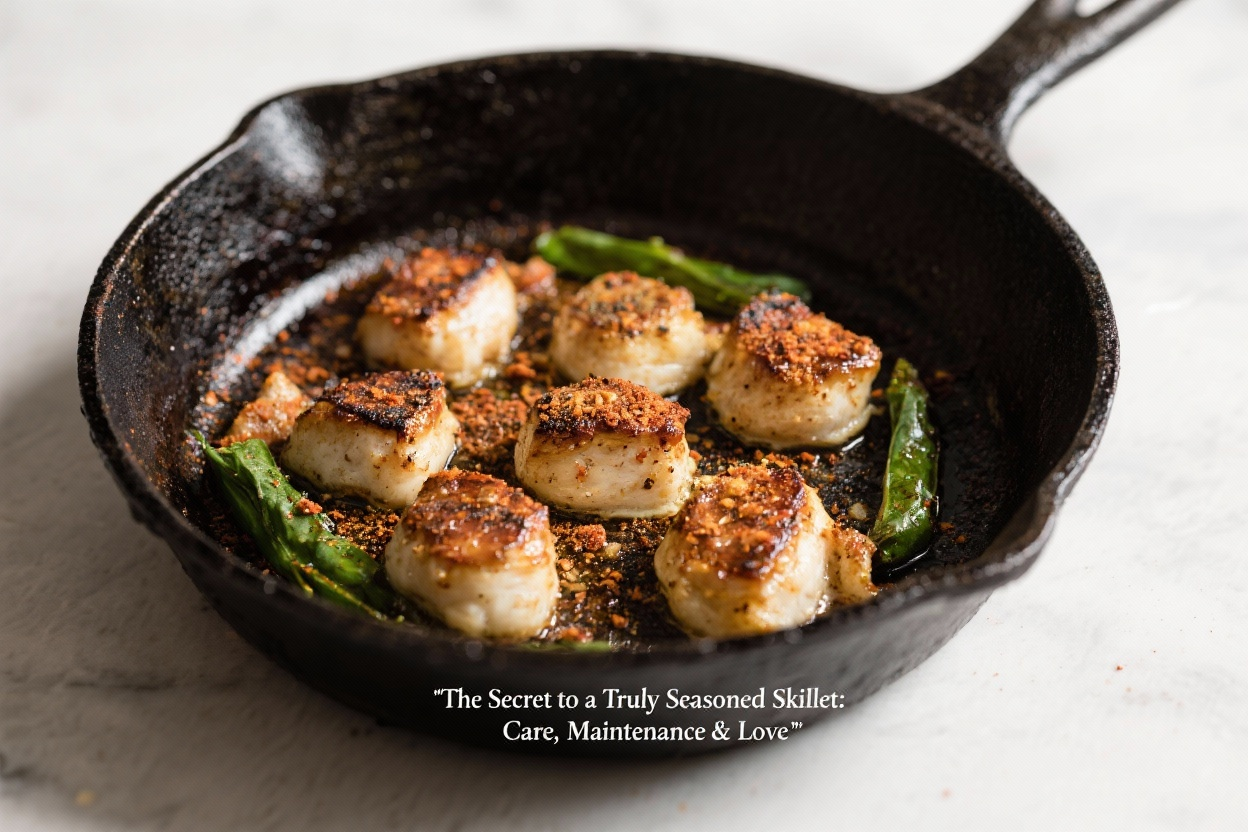
You want restaurant-level sear and crispy edges at home? It’s not a mystery; it’s maintenance. A properly seasoned skillet is a cheat code for flavor—and most people ruin it with one bad wash.
The good news: you don’t need fancy products or a culinary degree. You just need a system you can repeat, even on a Tuesday. Stick with me and your skillet will get better every time you use it—kind of like compounding interest, but tastier.
The Secret Behind This Recipe

Seasoning isn’t spice.
It’s polymerized oil: a hard, slick layer formed when thin coats of oil are heated past their smoke point and bond to the iron. That glossy, dark surface is what makes eggs slide, steaks crust, and clean-up painless. Here’s the twist: your skillet season is alive.
Every cook either strengthens it or scars it. Thin oil layers + high heat + regular use build a bombproof finish. Meanwhile, soaking, harsh detergents, and acidic stews strip it like a bad car wash. Treat your skillet like a cast-iron pet: feed it, keep it dry, and it will love you back.
Ingredients Breakdown
- Cast-iron or carbon-steel skillet (clean, dry, and fully heat-safe)
- High smoke point oil (flaxseed, grapeseed, canola, sunflower, or refined avocado)
- Coarse salt (as a gentle scrubber)
- Paper towels or a lint-free cloth
- Stiff brush or chainmail scrubber (optional, no harsh detergents)
- Oven (or stovetop if oven isn’t an option)
Instructions

- Preheat the skillet: Place it on low heat for 2–3 minutes to drive off hidden moisture.
A dry skillet is non-negotiable.
- Clean smart: If there’s stuck-on food, add a tablespoon of coarse salt and a splash of warm water. Scrub with a brush. Rinse quickly and heat again to dry.
- Thin oil coat: Add a few drops of oil to the warm pan.
Wipe until it looks dry. If you can see gleam or streaks, you used too much.
- Heat to set:
- Oven method: Place the pan upside down in a 450–500°F (230–260°C) oven for 60 minutes. Put foil underneath to catch drips.
Turn off the oven and let it cool inside.
- Stovetop method: Heat on medium-high until it just begins to smoke for 10–15 minutes. Let it cool. Repeat 2–3 times for new pans.
- Oven method: Place the pan upside down in a 450–500°F (230–260°C) oven for 60 minutes. Put foil underneath to catch drips.
- Use it often: Fry something fatty (bacon, sausages, smash burgers) the next few cooks.
This is seasoning in real time.
- After each use: While warm, wipe out. If needed, quick rinse, dry on heat, then apply a micro-coat of oil and buff until matte.
How to Store
- Keep it bone-dry: Dry on the stovetop for 2–3 minutes before storing. Moisture is rust’s love language.
- Oil kiss, not oil bath: Wipe a whisper-thin layer of oil before shelving.
It should feel dry to the touch.
- Airflow matters: Store with a paper towel between stacked pans to prevent scratching and trap humidity.
- If you spot rust: Scrub with steel wool, rinse, dry thoroughly, and re-season with the oven method. No drama.

Why This is Good for You
- Better flavor, less sticking: A good season equals reliable browning and easy flips. Eggs will finally behave.
- Healthier nonstick: No mystery coatings.
Just polymerized oil you control. Fewer chemicals, more confidence.
- Iron boost: Cooking in cast iron can increase dietary iron—especially helpful if you’re low. FYI, acidic foods increase transfer.
- Longevity and thrift: A well-kept skillet is basically immortal.
Your grandkids will inherit your patina (and your pancake recipe).
What Not to Do
- Don’t soak it: Long baths invite rust and lift seasoning. Clean promptly.
- Don’t use heavy soap daily: Occasional mild soap is fine, but frequent strong detergents erode the finish.
- Don’t leave it greasy: Puddled oil turns sticky and gummy. Always buff to a dry sheen.
- Don’t start with tomatoes or wine sauces: Acid can strip new seasoning.
Wait until your patina is robust.
- Don’t over-oil for seasoning: Thick coats create uneven, flaking layers. Thin is king.
- Don’t shock with cold water hot: Thermal shock can warp or crack, especially carbon steel.
Variations You Can Try
- Flaxseed oil build: Ultra-hard finish. Apply extremely thin coats and bake at 500°F.
Can be brittle if overdone—use sparingly.
- Bacon cure: Cook 2–3 rounds of bacon as your first cooks on a new pan. Delicious and functional. Win-win.
- Wok-style carbon steel: Heat over high flame, rub with cut ginger and scallion with oil for initial burn-in.
Old-school and effective.
- Salt scrub refresh: For sticky spots, warm the pan, add salt, scrub with a towel, wipe clean, and re-oil. Five-minute facelift.
- Hybrid oven + stovetop: One long oven bake to set, then monthly stovetop touch-ups. Maintenance that fits real life, IMO.
FAQ
Can I use soap on my cast iron?
Yes—mild soap occasionally won’t nuke your seasoning.
Just avoid intense degreasers and always dry on heat, then add a micro-coat of oil.
Why is my skillet sticky after seasoning?
You used too much oil or didn’t heat long enough. Strip the stickiness with a hot salt scrub, wipe clean, then re-season with a very thin coat and higher heat.
Is vegetable oil okay for seasoning?
Absolutely. Any high smoke point neutral oil works: canola, grapeseed, refined avocado, sunflower.
Consistency beats “perfect” oil.
How do I fix rust spots?
Scrub to bare metal with steel wool, rinse, dry on heat, then season in the oven at 450–500°F for an hour. Repeat 2–3 coats if needed.
Can I cook acidic foods in cast iron?
Yes, once your seasoning is mature. For new pans, avoid long-simmered tomato or wine dishes.
Short, quick acidic cooks are fine later.
What’s the difference between cast iron and carbon steel?
Cast iron is thicker and retains heat; carbon steel is lighter and heats faster. Care is nearly identical, but carbon steel is more sensitive to thermal shock.
Do I need to season a pre-seasoned skillet?
Pre-seasoning is a head start, not a finish line. Cook fatty foods early on and add a few thin oil bakes to level it up.
Why does my food still stick?
Pan too cold, insufficient fat, or immature seasoning.
Preheat until the pan passes the “water droplet dances” test, then cook.
Can I put my skillet in the dishwasher?
Hard no. Prolonged water, detergent, and high-heat drying are a triple threat to your seasoning.
How often should I re-season?
Light maintenance every use (wipe, dry, micro-oil). Full oven re-season only when the surface looks dull, rusty, or patchy.
Wrapping Up
A truly seasoned skillet isn’t luck—it’s a habit. Warm, clean, dry, micro-oil, and heat is the simple loop that makes cast iron unstoppable.
Cook fatty foods early, avoid the obvious traps, and watch your pan evolve from “just okay” to “how is this nonstick without Teflon?” Keep it consistent, and your skillet will pay you back with golden crusts and zero drama. Now go make something that sizzles.
Printable Recipe Card
Want just the essential recipe details without scrolling through the article? Get our printable recipe card with just the ingredients and instructions.
Printable Recipe Card
Want just the essential recipe details without scrolling through the article? Get our printable recipe card with just the ingredients and instructions.