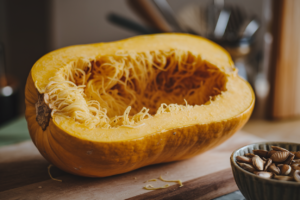
You want pasta without the carb coma? Spaghetti squash is your golden ticket—sweet, savory, and a total cheat code for weeknight dinners. One squash, two ingredients, and you’ll feel like you hacked the food matrix.
It’s cozy, satisfying, and shockingly simple to nail once you know the tricks. By the time you finish reading this, you’ll have a crispy-edged, fork-twirling bowl of strands that stands up to any sauce. And yes, your picky eater will ask for seconds.
What Makes This Special
Spaghetti squash gives you the noodle experience with none of the heaviness.
It turns into long, spaghetti-like strands that are naturally sweet and slightly nutty. Sauces cling to it beautifully, and it plays nice with everything—from marinara to pesto to garlicky butter. Unlike zucchini noodles, it holds texture and doesn’t get soggy when cooked right.
It’s also stupidly versatile: roast it, steam it, microwave it, or air-fry it. Plus, it’s budget-friendly, meal-prep friendly, and weeknight-proof. What’s not to love?
What You’ll Need (Ingredients)
- 1 medium spaghetti squash (about 2.5–3.5 pounds)
- 2–3 tablespoons olive oil or melted butter
- Salt and black pepper, to taste
- Optional aromatics: 2 cloves garlic (minced), 1 teaspoon Italian seasoning, pinch of red pepper flakes
- Optional finishers: grated Parmesan, fresh parsley or basil, lemon zest, or a squeeze of lemon juice
- For serving (optional): your favorite marinara, pesto, browned butter and sage, or sautéed mushrooms
Let’s Get Cooking – Instructions
- Preheat the oven to 400°F (205°C). Hot oven equals better caramelization and flavor.
Line a baking sheet with parchment for easier cleanup.
- Prep the squash safely. Trim a thin slice off both ends to create flat surfaces. Stand it upright and slice top to bottom with a sharp chef’s knife. If it’s stubborn, microwave the whole squash for 2–3 minutes first to soften the rind.
- Scoop the seeds. Use a spoon to remove seeds and stringy bits.
Don’t go overboard—you want to keep the firmer “walls” intact. FYI, you can roast the seeds later like pumpkin seeds.
- Season smart. Drizzle cut sides with olive oil or butter. Sprinkle with salt, pepper, and optional garlic or Italian seasoning. Season the cut side so the flavor hits the strands directly.
- Roast cut-side down for 30–45 minutes. Place halves cut-side down on the sheet.
Roast until the edges are golden and the rind yields when pressed. A fork should slide into the flesh with slight resistance.
- Rest, then shred. Let cool 5–10 minutes so the strands set. Flip, then use a fork to scrape from edges toward the center to form long “noodles.” Don’t over-scrape into mush.
- Finish in a skillet (pro tip). For restaurant-level texture, toss strands in a hot skillet with a little oil or butter for 2–3 minutes.
Add garlic or red pepper flakes, then finish with Parmesan and herbs. This drives off excess moisture and concentrates flavor.
- Serve your way. Top with marinara and meatballs, swirl in pesto, or go simple with lemon, parsley, and Parmesan. Want richness?
A pat of butter or a spoon of ricotta doesn’t hurt anyone.
Storage Instructions
- Fridge: Store cooked strands in an airtight container for 3–4 days. Keep sauces separate to preserve texture.
- Freezer: Freeze in zip-top bags (flattened) up to 2 months. Thaw in the fridge, then reheat in a hot skillet to evaporate moisture.
- Reheat: Skillet on medium with a drizzle of oil is best.
Microwave works in a pinch, but stop and stir to avoid steam-sog.
Why This is Good for You
Spaghetti squash is low-calorie and naturally gluten-free, with fiber to keep you full and steady your energy. It brings vitamins A, C, and B6 plus potassium and antioxidants—basically the wellness squad without the lecture. Swap it for regular pasta once or twice a week and you’ll feel the difference—lighter meals, same comfort.
It’s also a stealth veggie vehicle. Add spinach, mushrooms, or tomatoes and you’ve accidentally made a nutrient-packed bowl that tastes like it should be illegal. Balance, but make it delicious.
Common Mistakes to Avoid
- Overcooking into mush. If the strands collapse into a puddle, you went too far.
Pull when there’s gentle resistance.
- Skipping the skillet finish. Straight-from-oven strands can be wet. A quick sauté concentrates flavor and firms texture.
- Cutting only lengthwise for long strands. Hot take: for longer “noodles,” cut around the equator (across the width). The strands run in rings.
Choose the cut you prefer.
- Under-seasoning. It’s mild. Salt, fat, acid, heat—use them. Taste and adjust like you mean it.
- Drowning in sauce. You’re not hiding it; you’re ruining it.
Add sauce gradually so the squash still shines.
Recipe Variations
- Garlic-Parmesan Skillet: Sauté minced garlic in butter, toss squash, finish with Parmesan, parsley, and black pepper. A squeeze of lemon = chef’s kiss.
- Pesto “Pasta” Bowl: Toss warm strands with pesto, cherry tomatoes, and toasted pine nuts. Add grilled chicken for protein.
- Spicy Arrabbiata: Red pepper flakes, spicy tomato sauce, and torn basil.
Hit it with pecorino for extra bite.
- Carbonara-Inspired: Crisp pancetta, toss squash off heat with beaten egg and Parmesan until glossy. Add black pepper. Rich, fast, legendary.
- Herby Lemon Shrimp: Sauté shrimp with garlic and chili, toss with squash, lemon zest, and dill.
Weeknight date-night vibes.
- Stuffed Squash Boats: After roasting, fill shells with sautéed mushrooms, spinach, ricotta, and marinara. Top with mozzarella; broil until bubbly.
- Air Fryer Shortcut: Cut into rings, oil and season, air fry at 375°F for 12–16 minutes, flipping halfway. Scoop strands from each ring.
- Microwave Method (IMO acceptable): Place halves cut-side down in a dish with 1/2 inch water, microwave 10–15 minutes until tender.
Less browning, faster dinner.
FAQ
How do I know when the squash is done?
The rind should give when pressed, edges should look lightly caramelized, and a fork should slide in with slight resistance. If it’s watery or collapsing, it’s overcooked.
Can I cut it horizontally for longer strands?
Yes. Cutting around the equator preserves the natural ring-shaped strands, giving you longer “noodles.” Just scoop seeds from each half as usual.
What if my squash tastes bland?
Use more salt, add fat (olive oil or butter), and finish with acid (lemon juice) and heat (red pepper flakes).
Blandness is a seasoning problem, not a squash problem.
Is spaghetti squash keto or low-carb?
It’s low-carb compared to pasta and fits most low-carb and keto approaches. Check portions and sauces for your macros.
Can I meal prep this?
Absolutely. Roast, shred, and refrigerate the strands.
Reheat in a skillet throughout the week and change up the sauces so it never gets boring.
What sauces pair best?
Tomato-based, pesto, browned butter with sage, Alfredo-lite, or olive oil with garlic and herbs. It’s a flavor chameleon—most pasta sauces work.
Do I have to remove extra moisture?
If your strands seem wet, a quick sauté fixes it. You can also spread them on a towel-lined sheet for a minute or two to wick moisture, then season.
Wrapping Up
Spaghetti squash is the dinner hack that feels indulgent but keeps you light on your feet.
With a hot oven, a sharp knife, and a quick skillet finish, you’ll get springy, sauce-ready strands every time. Keep it simple or dress it up—either way, you’ve got a craveable, weeknight-worthy dish on lock. Now go make “pasta” that loves you back.
Printable Recipe Card
Want just the essential recipe details without scrolling through the article? Get our printable recipe card with just the ingredients and instructions.
Printable Recipe Card
Want just the essential recipe details without scrolling through the article? Get our printable recipe card with just the ingredients and instructions.